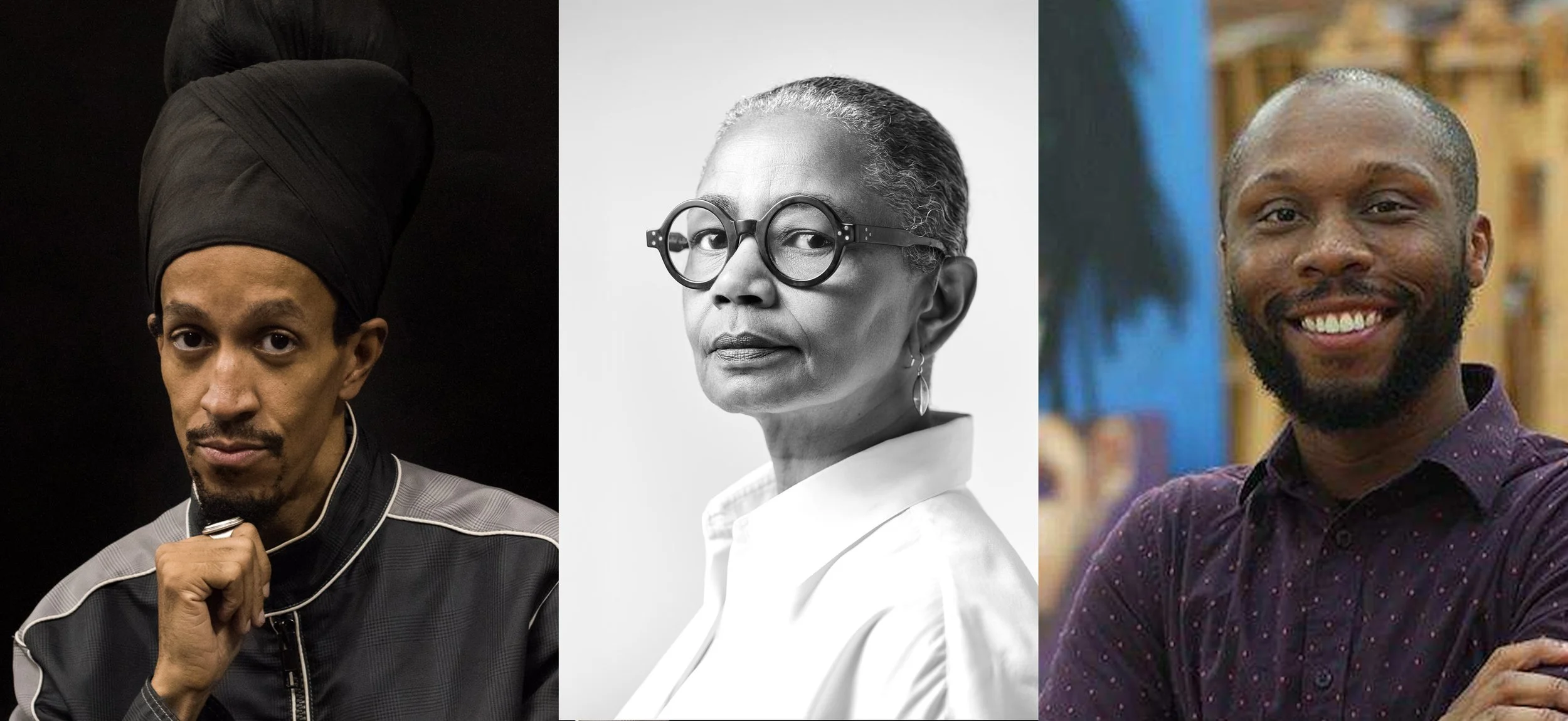
Pictured: André Leon Gray by Beth Mann, Precious D. Lovell by Sally Van Gorder, and William Paul Thomas by the artist.
No Study; No Celebration:
A Series of conversations
No Study; No Celebration is a series of conversations that studies Black On Black Project's three titular exhibitions in the context of North Carolina's history. Featuring artists from those shows, discussions will center what we've studied about our state in the past decade, using art to share how those learnings are applicable today. The free events invite artists André Leon Gray, William Paul Thomas, and Precious D. Lovell to consider who our community is and what our community has accomplished; each discussion will have a text associated with it, as only through study can we grasp a more complete picture of our history.
In 1950, Carter G. Woodson, the founder of Negro History Week, wrote "No Study and Consequently No Celebration" in which he implored learners to celebrate and share what they learned all year rather than limiting it to the week itself. These conversations, hosted at Anchorlight in Raleigh, NC, aim to help us "gain renewed vigor in [our] efforts to battle with present day obstacles" by revisiting a sampling of artworks from each exhibition — Black On Black, BOBV2, and BOBV3.
Featured discussions include:
Sunday, November 29, 2 p.m.: André Leon Gray
Raleigh-based artist André Leon Gray will discuss two of his works Keep it in the family and Say it louder for the people sleeping in the back. RSVP
Sunday, December 6, 2 p.m.: William Paul Thomas
Durham-based artist William Paul Thomas will discuss his portrait series Cyanosis, which suggests a parallel between literal oxygen deprivation and the toll of psychological and emotional distress. RSVP
Sunday, December 13, 2 p.m.: Precious D. Lovell
Raleigh-based artist Precious D. Lovell will discuss the origins of her work Legacy of the “N” Word that was featured in 2017’s BOBV2 and why she felt it necessary to create a work studying the word. RSVP
The events, hosted at Anchorlight, are part of a series reflecting on a decade of the Project’s work to nourish our cultural past, deepen our study, our understanding, and our connection.